I am really a novice photographer but I've had a lot of fun with it over the years. I wanted to share my photography portfolio blog here because it really has been taking up most of my meager spare time these past couple years. I've even been asked to do a number of portraits professionally of some of the other expat families here. I've really enjoyed that - the kids are so fun! But I also really love scenic photography and would like more practice with editorial-style photos. Anyways, if you like cute kids or pretty mountains, check it out: http://asphotographyportfolio.blogspot.jp/
I actually take an insane amount of photos - so I'm always looking back at some personal favorites and posting them. I decided it was finally time to put them all in one spot! Hope you like them, thank you!
Hunt Slonem's Lakeside in Louisiana
Tuesday, April 7, 2015
In researching Mr. Slonem's Louisiana restoration projects, I came across this 2007 NY Times article on his work at an 1832 plantation house called Lakeside. What a beautiful property and I like that this was more of rehabilitation than restoration in some of the details.
I have a distant relative involved in Charleston restoration. A big theme I took away from listening to him was the significance of restoration v. rehabilitation v. preservation. I know it is a contentious debate. But when I come across an interior that has been saved but not entirely finished, it captures the imagination a bit.
Hunt Slonem at Home in Louisiana
Tuesday, March 31, 2015
Maybe this is just on my mind because Easter is coming but Hunt Slonem might be known for his bunnies, but he is a man of many talents.
Did you know he collects Victoriana? Did you know he restored a few houses in Louisiana, including his Albania Plantation, and filled it with his collections and his own works?
Hotel Okura
Saturday, March 28, 2015
A recent article in Town and Country brought Hotel Okura to my attention. Apparently the potential remodel plans of the Minato, Tokyo hotel have upset many fans of mid-century design, rightly so. I have to say I have notced that here in Japan things are either new and modern or old and traditional - there's no in-between. I have to agree that preservation of something representative of Japanese design in the 1960's is worth saving. Especially considering that the head architect was Yoshiro Taniguchi.
The hotel opened in 1962. It is famous for appearing in Cary Grant's final movie,"Walk Don't Run" and a Sean Connery Bond film, "You Only Live Twice". This lobby looks so serene but very stylized for the era. The lanterns are traditional okura-style which is made in a 'kiriko tamagata' (faceted gem shape). The founder of the hotel was so inspired by these lanterns that they are the namesake.
I love the details in the tilework. This natural Tago sandstone accent wall has such a beautiful texture.
Of course there are economic pressures. This is a low-rise building in a very high-rent area. A high-rise would be substantially more profitable. But one can't ignore the magnificent design and details that would be lost. For example, the South Wing was added in the 1973 with this remarkable mosaic painting by Yoshiro Taniguchi based on the print "Saginawate-no-Saku" by Shimo Munakata.
In the Town and Country article they point to the paradox of Japan's lack of architectural conservation unless something is really, very old and survived quite by accident. I see it in talking to friends here. They would not live in a "used" house more than 20-30 years old. My friend Keiko says that, "bad energy from previous owners" would keep her from moving into an older home. Will Hotel Okura go the way of Kenzo Tange's Akasaka Prince Hotel and Frank Lloyd Wright's Imperial Hotel?
Sources: Monocle, Town & Country and Hotel Okura
I love the details in the tilework. This natural Tago sandstone accent wall has such a beautiful texture.
Of course there are economic pressures. This is a low-rise building in a very high-rent area. A high-rise would be substantially more profitable. But one can't ignore the magnificent design and details that would be lost. For example, the South Wing was added in the 1973 with this remarkable mosaic painting by Yoshiro Taniguchi based on the print "Saginawate-no-Saku" by Shimo Munakata.
Some more details, I love the textures!
Sources: Monocle, Town & Country and Hotel Okura
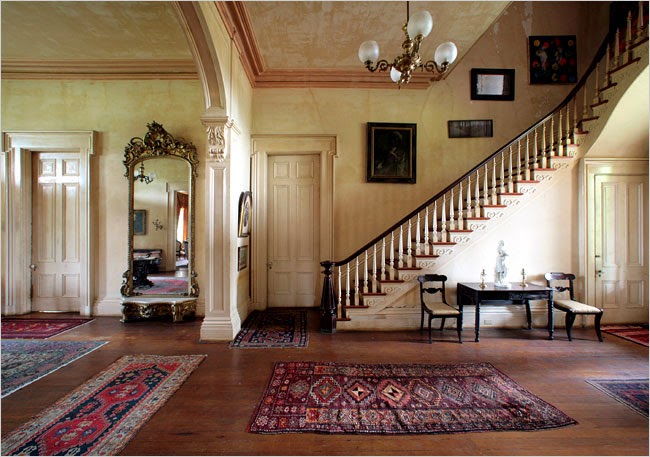
Hemingway's Key West Estate in Domino
Tuesday, March 24, 2015
Somehow while living in Florida for five years, I never made it to Key West. Life just gets busy! But I have wanted to go mostly to take a tour of Ernest Hemingway's house. I was really excited to see these beautiful photos of the place in a tour on Domino's website.